.png)
fREQUENTLY ASKED QUESTIONS
General FAQs
Q. Why did you choose the name “Invictus” for your services?
A. I chose this name because I fell in love with the “Invictus” poem written by the Victorian-era British poet William Ernest Henley in 1875. The poem captured my attention as a high school student because it spoke with such conviction about maintain perseverance, courage, and integrity while taking control of your life’s path. The sentiment of this charge has stuck with me over the years and now it informs my desire to help clients and their loved ones be the captain of their own grief and death processes.
Q. Will insurance or Medicare cover Death Doula or Grief Peer Support/Coaching services?
A. Unfortunately, these services are not currently covered by any insurance. All of my services are self-pay. While these services are not currently covered by insurance or Medicare, it's worth keeping an eye on potential coverage in the future.
Pricing has been structured to maintain accessibility and affordability and is commensurate with other providers in this geographic area. Please contact Genna via email if you have questions about sliding scale and/or pro bono work.
Q. Can I work with you if I’m
not in New Mexico?
A. Yes. I work with clients virtually, which means you can meet with me from anywhere.
All one-on-one grief support and coaching sessions are offered online through secure video, allowing us to connect regardless of location. Many clients appreciate the flexibility and privacy that virtual sessions provide — especially during seasons when leaving home feels difficult.
Because my services are non-clinical and do not involve therapy or mental health treatment, I am able to offer grief peer support and coaching across state lines.
If you’re unsure whether virtual support will feel meaningful or effective for you, I’m happy to talk that through during a discovery conversation. Grief support can be steady and connected, even across distance.
Q. What if I’m having
suicidal thoughts or a crisis?
A. Your safety matters first and foremost.
Invictus by Genna provides non-clinical grief support and coaching — not emergency mental health crisis intervention or clinical treatment.
If you are experiencing thoughts of harming yourself or feel you are in crisis right now, please reach out for immediate help from trained crisis professionals.
-
If you are in the United States and need urgent support, you can call or text 988, the national Suicide & Crisis Lifeline, any time, day or night.
-
If you are outside the U.S., please contact your local emergency number or crisis hotline (911) for immediate assistance.
These services are trained to help people in crisis and can connect you with resources that are appropriate to your situation.
During grief support work together, if you disclose thoughts of self-harm or significant safety concerns, we will address them with seriousness and care. Part of our ongoing work will include assessing needs and, if appropriate, encouraging and supporting you in connecting with clinical care, crisis services, or other qualified resources.
Grief can intensify pain and despair, and you do not have to manage that alone. If you are in immediate danger or feel unsafe, please seek help from emergency services or a crisis hotline right now — your life is valuable and there are people and services prepared to help you through moments like these.
Q. How do I know
what services I need?
A. The best way to find out which services you need and want is for us to talk together to learn about your personal circumstances. I call this a Discovery Session – a free 20-minute consultation via phone call or video chat. You can review the list of my services online first here, but it is not required. The beauty of working with me is that the process is personalized to you and your unique circumstances. I invite any questions you may have and look forward to discussing how I can best support you.

Grief Support FAQs
Q. What does "peer counselor" mean? What is your role, exactly?
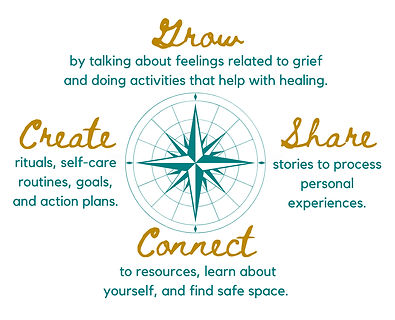
A. At Invictus, peer counseling is guided by the compass you see below. My role is not to diagnose or treat you, but to help you orient yourself after loss, trauma, or life disruption—when your internal sense of direction may feel altered or uncertain. My role is to be a steady port in the storm—a place where you can safely express, explore, and make sense of your grief experience.
Our work together centers around four core processes:
-
Share — creating space for you to speak openly about your experiences, emotions, and story
-
Connect — helping you reconnect with yourself, supportive resources, and a sense of safety
-
Grow — supporting emotional integration and helping you understand how grief and trauma affect the brain, body, and identity
-
Create — developing rituals, routines, goals, and action plans that help you move forward in a way that feels authentic and sustainable
I offer a steady, knowledgeable presence grounded in professional training, lived understanding of grief, and years of companioning others through profound life transitions. I may offer reflection, education, research knowledge and experience, and practical tools—but you remain the expert on your own life. Like a compass, my role is not to choose your direction, but to help you find your bearings and move forward with greater clarity and self-trust.
_edited.jpg)
Q. Are you a licensed,
clinical counselor?
A. No, I am not a licensed clinical counselor. I am a peer counselor. I do not provide therapy, mental health counseling, or clinical treatment. I offer non-clinical grief peer support and coaching focused on emotional support, education, and navigating life after loss.
I provide grief support, education, and coaching, not psychotherapy or clinical treatment. I cannot diagnose, prescribe, or treat mental health conditions. My work is grounded in evidence-informed grief education and compassionate presence, and I often complement—not replace—clinical care. When someone needs clinical or therapeutic support, I encourage and support connection with licensed mental health providers.
Read more about my qualifications and training on the About Genna page.
Q. What kinds of losses
do you support?
I support people navigating many forms of loss — not only death.
Grief is not limited to one type of event, and it doesn’t follow a hierarchy. If something meaningful has changed, ended, or been taken from you, grief may be present.
Some of the losses I commonly support include:
-
Death of a loved one (including sudden, traumatic, or anticipated loss)
-
Suicide loss
-
Loss related to chronic illness or medical diagnoses
-
Anticipatory grief while caregiving
-
Changes in identity after caregiving ends
-
Divorce or separation
-
Estrangement from family members
-
Friendship loss
-
Infertility, miscarriage, pregnancy loss, or reproductive transitions
-
Loss of a hoped-for future
-
Job loss or major life transitions/workplace trauma
-
Pet loss
-
Relocation or community loss
-
Shifts in faith or belief systems
-
Ambiguous loss (when someone is physically present but psychologically absent, such as dementia or addiction)
Sometimes people come to me unsure whether what they’re experiencing “counts” as grief. If it matters to you, it matters here.
My work focuses on supporting you in understanding your experience, building tools for living with loss, and navigating the emotional and practical ripple effects that follow. Grief can impact identity, relationships, purpose, and daily functioning — and all of that is welcome in this space.
Q. How is grief support or grief coaching different from therapy?
A. Grief support and grief coaching are not therapy, and they are not meant to replace therapy. This work focuses on companionship, education, active listening, reflection, and practical support as you navigate life after loss.
Therapy typically involves diagnosis, treatment of mental health conditions, and clinical interventions. My role is different. I walk alongside people in grief—helping them make sense of what they’re experiencing, normalize grief responses, understand how grief affects the brain and body, and explore ways to live with loss rather than trying to “fix” it.
Many people choose to work with me alongside therapy, during transitions between therapists, or during seasons when therapy isn’t the right fit. If at any point someone would benefit from clinical mental health care, I support them in exploring appropriate referrals.
Q. Can I be referred to a clinical therapist if I need that level of care?
A. Yes, absolutely! And I maintain a list of trusted referrals.
Because I am not a clinical provider, part of my responsibility in our work together is to remain attentive to your overall well-being. If at any point it becomes clear that you would benefit from licensed mental health care, we will talk about that openly and collaboratively.
Referral is not a failure. It is simply about making sure you have the right level of support for what you are carrying.
Sometimes clients work with me alongside a therapist. Sometimes grief support begins first, and therapy is added later. Sometimes people transition fully into clinical care. Every situation is different, and decisions are made with care and transparency.
If higher-level care is appropriate, I will help you explore options and next steps so you are not navigating that alone.
My priority is always that you receive the support that best serves you.
Q. What is your philosphy around grief and grief support/education?
A. Grief doesn’t need to be fixed to be supported. It needs space, understanding, and care.
My work is rooted in the belief that grief is a human experience, not a problem to solve. It is a natural response to love, attachment, identity, and meaning. When something or someone significant changes or is lost, our minds and bodies respond. That response is not pathology — it is evidence of connection.
In many spaces, grief is treated as something to manage, contain, or move through as efficiently as possible. I take a different approach. I believe grief deserves witness rather than correction. Curiosity rather than urgency. Education rather than fear.
I do not see people in grief as broken. I see people navigating disorientation. Grief can alter identity, relationships, routines, belief systems, and the way the brain processes the world. Understanding those shifts helps reduce shame. Education about how grief affects the brain and body can be stabilizing. Naming what is happening often brings relief.
My approach blends companionship, grief literacy, and practical navigation. Together, we explore what your loss has changed, what it has disrupted, and what still remains. We build internal and external supports. We allow for both sorrow and growth, both longing and forward movement. There is no timeline to impose and no emotional benchmark to reach.
This work is not about helping you “get over” grief. It is about helping you live with it — in ways that feel integrated, supported, and grounded in your values.
I also believe grief belongs in community. Much of the suffering around grief comes not from the loss itself, but from isolation, misunderstanding, and the pressure to appear “okay.” Education reduces stigma. Conversation builds connection. When we increase grief literacy, we create cultures that respond with steadiness rather than avoidance.
Q. How long does each session last and how often do we meet?
A. Individual grief support sessions are typically 50–60 minutes, and can go up to 90 minutes.
How often we meet depends on your needs, the season you’re in, and the kind of support that feels most helpful. Some people choose to meet weekly during more intense or early stages of grief. Others prefer biweekly or monthly sessions for steady reflection and integration. Some clients schedule one-time or occasional sessions around anniversaries, transitions, or specific challenges.
There is no required timeline. Grief does not move on a fixed schedule, and neither does support.
At the beginning of our work, we’ll talk together about what frequency feels supportive and sustainable. That plan can shift over time as your needs change. My goal is to offer structure without pressure and consistency without urgency.
You don’t have to commit to a long-term process before you’re ready — and you also don’t have to rush your support.
Q. Is there a "right time" to start grief and loss support with you?
A. There isn’t a single right time.
Some people reach out within days or weeks of a loss because everything feels disorienting and they want steady support early on. Others come months or years later, when the initial shock has settled and the deeper layers begin to surface. Some people seek support around anniversaries, life transitions, or when grief reappears in unexpected ways.
Grief doesn’t follow a clean timeline. It moves in waves, seasons, and spirals.
It is not “too soon” if you want grounding and understanding while everything feels raw.
It is not “too late” if you are realizing the loss still lives in you.
Often, the question isn’t about timing — it’s about readiness. If you are curious about your experience, feeling stuck, carrying something alone, or simply wanting a space where grief doesn’t need to be minimized, that may be reason enough.
Support is not an emergency measure. It is a place to be witnessed, to learn about what your brain and body are doing in grief, and to build steadiness over time.
You don’t have to wait until you’re falling apart.
And you don’t have to justify why you’re still grieving.
If it matters to you now, it’s the right time to consider support.
Q. Who might benefit most from peer counseling at Invictus? / Who is peer counseling at Invictus designed to support? / Who is peer counseling at Invictus especially meaningful for?
A. Peer counseling at Invictus is especially meaningful for those who want a steady, relational space to express, process, and integrate their grief or life transition.
You may find this work especially helpful if you:
-
Are navigating grief, trauma, or major life transitions
-
Feel changed by what they’ve experienced and are working to understand who they are now
-
Want support that is relational and non-clinical, without being pathologized or “treated”
-
Are highly self-aware but feel stuck, untethered, or alone in what they’re carrying
-
Are seeking someone to actively listen
-
Are functioning outwardly, but know internally that something important needs attention
-
Are seeking integration—not just coping, but learning how to live alongside what has happened
-
Want guidance in creating meaningful next steps, rituals, or structure after loss - including guided activities, discussion prompts, custom worksheets, and more
Q. Are there particular grief experiences or topics you specialize in?
A. Yes. I often work with people whose grief feels complex, layered, or hard to talk about openly.
Not all grief looks like sadness alone. Sometimes grief also includes relief, anger, guilt, or even a sense of freedom—especially when a loss follows a difficult relationship, a long illness, or years of caregiving. These feelings are normal and valid, even if others don’t always understand them. I offer a space where you can speak honestly about your experience without judgment.
I commonly support people who are navigating:
-
The death of a spouse or partner, including relationships that were loving, strained, distant, or harmful
-
Grief that includes relief, freedom, or mixed emotions
-
Loss after caregiving, and the adjustment that follows
-
Changes in identity or sense of self after a loss
-
Grief connected to trauma or difficult relationship history
-
Sudden or unexpected loss
-
Feeling outwardly “okay,” but internally changed or unsettled
-
Caregivers, helpers, and professionals who are used to supporting others
-
Major life changes that follow loss, including shifts in role, purpose, or direction
You do not have to hide or explain your feelings here. Your experience is welcome.
*This is not a complete list. Every grief experience is different. I warmly invite you to reach out so we can talk about what you’re carrying and what support may be helpful.
Death Doula FAQs
Q. What is a Death Doula?
A. A "Death Doula” is an emerging role in death and grief care. Much like a Birth Doula ushers a new life into the world, a Death Doula helps individuals through the labor of ending life and concluding their human existence. A Death Doula guides a person who is transitioning to death and their loved ones through the dying process. The doula will provide non-medical emotional, spiritual, and physical support to everyone involved. Above all, the doula listens deeply to the concerns, fears, hopes, and life stories of the dying person and their loved ones to bring them peace at the end of life. The doula holds the space for the kind of dying experience that honors who the ill person is and has been in their life and helps them live with purpose up to the final breath. The doula also supports the individual's family and friends.
Q. My dying loved one has declined to work with a Death Doula, but I still need outside grief support and education. Can I work with you?
A. Yes! Invictus By Genna: Grief & Loss Services offers full-spectrum peer support for the dying, as well as their caretakers and loved ones. It is a common occurrence for loved ones to seek out the support of a Death Doula or mental health professional when the dying person has decided not to participate. Let’s chat about how I can best support you.
Q. Do you work with clients who are considering MAiD and VSED?
A. Yes. I work with individuals and families who are considering or navigating MAiD (Medical Aid in Dying) or VSED (Voluntarily Stopping Eating and Drinking) by offering grief support, education, and emotional respite. My role focuses on helping people process the emotional, relational, and meaning-making aspects of these decisions and experiences.
At this time, I do not provide active monitoring or practical support during the dying process itself. When clients need hands-on, clinical, or bedside support during active dying, I encourage and help connect them with appropriate medical, hospice, or end-of-life care providers.
Please see my Resources page for preferred partners.
practical support FAQs
Funeral celebrancy, legacy projects, eulogy and obituary writing, etc.
COMING SOON